The Hat Creek area in northeastern California, located between Lassen Peak and Mount Shasta, features diverse volcanic and tectonic geology. The landscape has been shaped by volcanic eruptions, basaltic lava flows, tectonic faulting, and glacial activity.
The Volcanos
Mt. Lassen and Mt Shasta are part of the Cascade Arc. The Cascade Volcanic Arc was created by the subduction of the Juan de Fuca oceanic plate beneath the North American continental plate at the Cascadia subduction zone. This process releases water from the subducting plate, which lowers the melting point of the overlying mantle rock, leading to magma formation and volcanic eruptions. Crater Peak (NW of Lassen) is a cinder cone formed from basaltic to basaltic-andesite lava eruptions. likely erupted ~15,000–10,000 years ago. Burney Mountain is a shield volcano with a broad, gently sloping profile, characteristic of fluid lava eruptions. It’s estimated age is ~200,000 to 300,000 years.
Mt. Lassen
Mt Lassen is a lava dome volcano formed around 27,000 years ago, composed primarily of dacite, a viscous, silica-rich volcanic rock. Lassen is part of the larger Lassen Volcanic Center, which has been volcanically active for over 825,000 years. This volcanic center includes older stratovolcanoes and calderas, such as Brokeoff Volcano. The peak formed from repeated dome-building eruptions of thick lava, and its current form is largely due to eruptions between 27,000 and 18,000 years ago. The most recent eruptive activity occurred from 1914 to 1921, including a significant eruption in 1915, which produced a pyroclastic flow, lahars, and ash clouds.
The Hat Creek Rim
The Hat Creek Rim is a fault scarp, a steep slope formed by fault movement where one side of the fault has moved vertically relative to the other. Specifically, the valley floor of Hat Creek Valley has dropped approximately 900 feet below the rim due to faulting. This faulting is still active, with the region experiencing ongoing seismic activity. The rim itself is a remnant of the landscape before the faulting occurred, and the dramatic difference in elevation is a result of this geological event. The dramatic drop that created the rim occurred over a long period, estimated to be about a million years.
It is a normal fault scarp related to regional extensional tectonics of the Basin and Range Province where the crust is being pulled apart. The faulting here has produced a tilted fault block, with the western side dropping down relative to the eastern side, creating the steep cliffs of the Rim. The escarpment marks the edge of the Hat Creek graben, a down-dropped block of crust bounded by faults. The Rim exposes many layers of basaltic lava flows, some dating back hundreds of thousands of years, overlying older volcanic and sedimentary rocks.
Glaciers
Glacial activity in the Hat Creek area was moderate but significant, primarily influenced by alpine glaciers that originated from nearby high elevations, such as Lassen Peak and Brokeoff Mountain, during the Late Pleistocene (~25,000 to 15,000 years ago). While Hat Creek Valley itself was not directly glaciated, it was heavily shaped by glacial runoff, sediment deposition, and erosional processes from nearby glaciated highlands.
Glacial meltwater scoured the valley, depositing outwash sediments that shaped streambeds and floodplains. Hat Creek itself likely owes part of its path and incision to meltwater surges from retreating glaciers. These surges contributed to fan deposits, alluvium, and fine sediments in the lower Hat Creek area.
The area’s volcanic history intersects with glacial history. Lava flows overlapped older glacial deposits. Some post-glacial basaltic flows (like the Hat Creek basalt) filled valleys carved by glaciers. Subsequent lava flows (e.g., from vents north of Lassen) were partly redirected by glacial terrain.
Lavas
Lavas vary in composition depending on what minerals they pick up as they rise to the surface. Basaltic lavas low in silicon have a low viscosity and flow easily. (pahoehoe). Andesite lavas have a moderate silicon content and a moderate viscosity (common to Mt. Shasta). Dacite lavas are silica rich and have a high viscosity (common to Mt. Lassen).
Lava Flows and Cave Formation
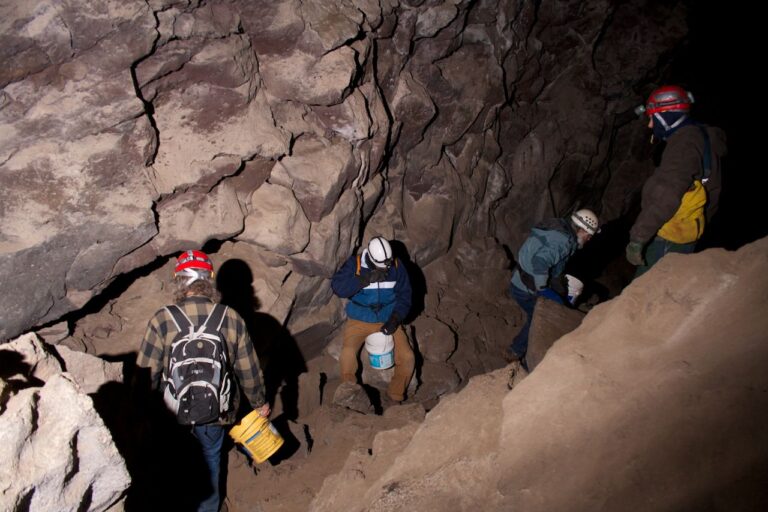
The caves in the Hat Creek Area were formed by a lava flow originating in the Old Station area that flowed north (down) the Hat Creek drainage about 20,000 years ago. Lava tubes are formed in flowing basalt lava commonly called Pahoehoe (pah-hoh-ey-hoh-ey). Tubes (caves ) form when the surface cools forming a crust, then the interior molten lava continues to flow and eventually drains forming an empty tube.